
Turning Your Website Into a Growth Engine
A co-sponsored webinar presented by Withum and InstaVert
Your website should be more than a digital brochure. It should actively help your organization attract the right buyers, build trust, generate qualified opportunities, and accelerate growth.
In this webinar, Laura Whitman, Partner at Withum, and John Bertoli, Founder of Bertoli Marketing and InstaVert and a Fractional CMO, discuss how businesses can transform their websites into true growth engines.
The conversation explores stronger conversion strategy, better buyer alignment, more effective content experiences, conversion rate optimization, and the emerging role of real-time website optimization.
Introduction
Laura Whitman:
Hello, everyone. I’m Laura Whitman, a Partner at Withum in our advisory practice. I work closely with small and mid-sized businesses on their accounting and financial operations.
Our accounting teams partner with growing companies to bring structure, visibility, and meaningful insight into their financial data so leadership can make informed, strategic decisions.
I’m excited to be part of today’s session alongside industry peer John Bertoli, Founder of Bertoli Marketing and InstaVert and a Fractional CMO. He’ll be sharing his perspective on how businesses can leverage their websites and marketing strategies to drive growth.
John, I’ll turn it over to you.
John Bertoli:
Thank you, Laura, and thank you to Withum for having me.
Today, we’re going to discuss how organizations can turn their websites into true growth engines, focusing on stronger conversion strategy, better buyer alignment, more effective content experiences, and modern website optimization approaches.
One thing I’ve learned throughout my career leading marketing teams and auditing websites is that many organizations are successfully driving traffic but still struggle to consistently generate qualified opportunities from their digital experience.
Usually, the issue isn’t effort.
Most organizations are investing heavily in advertising, content, branding, SEO, digital campaigns, and other marketing initiatives. But the website itself often isn’t strategically designed to move buyers forward effectively.
That’s what we’re going to discuss today.
Are Your Website Visitors Actually Converting?
I’d like to start with a question: Are you satisfied with the leads generated from your website?
For many organizations, the answer is no.
The next question is: Have you done any conversion-focused website optimization in the past year?
Many organizations aren’t actively focused on website conversion optimization. They may know there’s a problem but don’t know where to start, or they simply don’t have the time or bandwidth to focus on it.
We’re all trying to do more with less, especially in today’s increasingly AI-driven business environment.
One of the biggest patterns I see when reviewing websites is that many organizations optimize heavily for appearance but not necessarily for conversion outcomes.
The website might look modern. The branding is polished. The navigation is clean. But when you step back and evaluate the experience through the lens of a prospective buyer, major gaps often appear.
A visitor may still be asking:
- What problem does this company actually solve?
- Why is this company different?
- Who is this specifically for?
- What should I do next?
- Why should I trust them?
Those answers aren’t always immediately clear.
Organizations frequently focus heavily on branding, visuals, and site structure while underinvesting in buyer psychology, conversion sequencing, differentiation, and trust development.
One question I often ask during website reviews is:
If a completely new visitor landed on your homepage for 10 seconds, would they clearly understand what you do, who you help, and why you’re different?
Surprisingly often, the answer is no.
The messaging may sound polished internally, but from the buyer’s perspective, it’s vague.
Organizations also underestimate how quickly visitors make judgments. Most visitors aren’t carefully reading every section of your website. They’re scanning headlines, structure, visuals, trust indicators, and calls to action.
They’re trying to answer one fundamental question:
Is this relevant to me?
Companies may spend heavily to drive traffic from Google Ads, LinkedIn, conferences, outbound campaigns, webinars, and other channels, only for those visitors to arrive at a website that creates confusion instead of momentum.
That’s where website optimization becomes incredibly important.
Why Visually Impressive Websites Still Fail to Convert
A visually impressive website can still create a weak buying experience.
Organizations often unintentionally optimize their websites around internal preferences rather than buyer clarity. That typically creates problems such as generic messaging, weak differentiation, unclear conversion paths, and static user experiences.
One of the biggest conversion killers is generic messaging.
If a prospect lands on your website and your messaging sounds interchangeable with your competitors, they’ll struggle to understand why they should engage further.
Websites can’t be everything to everyone.
That’s why we tend to focus on Ideal Customer Profile, or ICP, strategy early in our engagements with clients.
When businesses attempt to speak to everyone, the result is usually broad messaging that sounds safe internally but weak externally.
For example, many websites use phrases such as:
“Innovative solutions.”
“Transforming your business.”
“Driving digital excellence.”
But none of those statements actually explains the problem the company solves, the outcome it creates, or why the buyer should care.
The strongest websites tend to be much more direct and outcome-oriented.
Build a Better CTA Hierarchy
Another common issue is poor CTA hierarchy.
Many organizations immediately push visitors toward high-friction actions such as Book a Demo or Contact Sales before enough trust or context has been established.
We recently released a case study in which a client’s better-performing CTA was Preview the Platform rather than Request a Demo.
The softer CTA converted approximately five times better during our experimentation.
The strongest websites create progressive engagement paths based on buyer readiness.
Organizations often overestimate buyer patience. If visitors have to work to understand your value proposition, they’re likely to leave.
These website issues often connect back to broader operational marketing challenges. Organizations are dealing with limited resources, pressure to generate pipeline, inconsistent lead quality, and difficulty aligning sales and marketing expectations.
We frequently see organizations generating activity without generating momentum.
Marketing teams are driving traffic. Content is being produced. Campaigns are running. But the experience isn’t consistently converting visitors into high-quality opportunities.
The root cause frequently comes back to messaging alignment, ICP clarity, buyer journey friction, and gaps in the website experience.
Your Website Is Increasingly Your First Sales Interaction
Marketing teams are under increasing pressure to demonstrate business impact while many organizations operate with leaner teams, tighter budgets, and higher growth expectations.
That puts more pressure on the website.
The website increasingly becomes the first sales interaction, the first trust-building interaction, and often the first evaluation experience a prospective customer has with your company.
At the same time, there’s a growing gap between traffic generation and conversion effectiveness.
Organizations know how to drive traffic better than ever. There are countless channels available to bring people to a website.
Converting that traffic efficiently and effectively is where many organizations struggle.
Not Every Website Visitor Is Ready to Convert
One of the biggest mistakes organizations make is assuming every visitor is immediately ready to convert.
In reality, buyers arrive at very different stages.
One visitor may be trying to understand the problem. Another may be evaluating possible solutions. Another may be comparing providers. Others may be evaluating risk before making a final decision.
Yet many websites treat every visitor exactly the same.
Organizations frequently push high-friction conversion actions too early.
The strongest-performing websites guide visitors progressively through the buyer journey. They educate first, build trust, reinforce confidence, and then drive conversion.
One thing I always remind organizations is:
Buyers don’t wake up wanting to book demos. Buyers wake up trying to solve problems.
That’s an important distinction.
The strongest websites acknowledge where buyers are psychologically.
For example, someone researching cybersecurity risks behaves differently from someone actively comparing cybersecurity vendors.
Their questions are different. Their urgency is different. Their trust requirements are different.
The website experience should reflect those differences.
Build Your Website Around Your Ideal Customer Profile
One of the most valuable exercises an organization can undertake is a true ICP website audit.
When I say ICP, I don’t simply mean industry targeting.
A strong Ideal Customer Profile requires understanding:
- Operational pain points
- Decision-making structures
- Buying signals
- Organizational priorities
- Business motivations
- Key objections
- Decision-makers and influencers
- Characteristics of strong-fit and weak-fit customers
Many organizations broadly know who they want to sell to, but they haven’t fully mapped why those buyers engage, what creates urgency around a purchase, what objections exist, or what differentiates a strong-fit customer from a weak-fit customer.
That deeper understanding dramatically improves website messaging, content strategy, campaign targeting, and overall conversion performance.
ICP work is one of the first things we do with clients and prospects. We want to understand what the organization does, what it does particularly well, and the pain points its content needs to address.
Without that foundation, it’s difficult to fully understand who your customers are, what they’re trying to accomplish when they reach your website, and what content will encourage them to engage.
Two companies in the same industry may buy for completely different reasons.
One may be driven by cost reduction. Another may be driven by compliance. Another by growth. Another by operational inefficiency.
If your website treats all of those buyers the same, the messaging becomes generic.
A strong ICP clarifies which audience segments matter most, what those audiences care about, what language they use, what objections they have, and which content and proof points will help move them forward.
Your ICP should influence almost every part of the website, from homepage messaging and navigation to content strategy, landing pages, CTAs, case studies, and even what you choose not to emphasize.
The stronger your ICP clarity, the easier it becomes to create a website experience that feels relevant, specific, and credible to the right buyers.
Treat Content as a Buyer Enablement System
Another major shift organizations can make is treating content as a strategic buyer enablement system, rather than simply an SEO exercise.
The strongest content strategies progressively move buyers toward greater confidence.
Thought leadership content creates awareness and credibility.
Solution-oriented content helps buyers understand fit.
Validation content reduces risk and strengthens buying confidence.
High-performing organizations intentionally map content to the buyer journey. eBooks, webinars, blogs, solution briefs, videos, infographics, case studies, ROI analyses, and other assets should each have a purpose within that journey.
When auditing a website, we often inventory the content that exists and map it to the buyer journey to identify gaps.
An organization may be creating significant amounts of thought leadership but lack solution-oriented content. Or it may not effectively communicate its value story. Others lack validation through case studies, ROI analysis, or total cost of ownership documentation.
Strong-performing organizations treat content as part of the revenue process, not simply as marketing activity.
Content should answer questions before sales conversations happen.
It should reduce uncertainty before buyers speak with your team.
It should help buyers justify decisions internally.
The strongest content strategies create momentum before sales engagement even begins.
Use Content Sequencing to Build Buyer Confidence
Consider how strategic content sequencing can work.
A prospect might initially engage with educational content discussing a broad industry challenge. That creates awareness and relevance.
From there, the prospect may move into solution-focused content explaining different approaches or methodologies.
Then validation content reinforces trust through proof, outcomes, and credibility.
At that point, conversion becomes much more natural because the visitor already understands the problem, the solution, and the potential value.
Organizations often try to accelerate conversion when they should instead be accelerating conviction.
The strongest buyer journeys feel natural rather than forced.
The prospect feels educated rather than sold to, which can improve both conversion quality and sales efficiency.
What Modern Conversion Rate Optimization Really Means
Modern conversion rate optimization is much broader than many organizations realize.
CRO isn’t simply testing headlines or changing button colors.
Modern CRO incorporates buyer psychology, messaging clarity, trust development, usability, content orchestration, friction reduction, and behavioral understanding.
Every visitor is subconsciously evaluating:
Is this relevant to me?
Does this organization understand my challenges?
Do I trust them?
Is this worth my time?
The strongest websites reduce uncertainty quickly and create momentum.
It’s also important to recognize that optimization shouldn’t be viewed as manipulation.
Good optimization is about improving clarity and reducing friction.
Sometimes relatively small changes can create significant impact. Simplifying messaging, reducing unnecessary form fields, clarifying CTAs, adding trust indicators, or restructuring content flows can outperform major redesigns because they improve comprehension and confidence.
Website Optimization Should Be an Ongoing Discipline
One thing we’ve learned from managing marketing programs is that sustainable growth rarely comes from isolated campaigns.
The strongest-performing organizations create systems.
That means continuous content development, SEO improvement, webinar programs, reporting refinement, sales alignment, automation, and ongoing optimization.
Website optimization works best when integrated into a broader operational growth strategy rather than treated as a one-time design initiative.
Many organizations redesign a website and then essentially leave it untouched for years.
Meanwhile, buyer behavior changes. Competitors evolve. Messaging shifts. Search behavior changes.
Website optimization should function as an ongoing discipline rather than a one-time event.
Six Practical Website Optimization Improvements
There are six practical improvements organizations can begin implementing relatively quickly.
1. Clarify homepage positioning.
Evaluate your positioning through the lens of the buyer rather than relying on internal company language. Put yourself in the buyer’s seat and ask whether your value is immediately apparent.
2. Improve CTA hierarchy.
Not every visitor is ready for a high-friction conversion immediately. Give visitors logical next steps based on their level of intent and readiness.
3. Add validation near conversion points.
Trust signals matter significantly during evaluation. Testimonials, case studies, client logos, quantified outcomes, and other proof can reduce perceived risk.
4. Align content with buyer journey stages.
Different visitors require different information. Build content that supports awareness, evaluation, validation, and conversion.
5. Analyze behavioral drop-off points.
Understand where engagement declines and where friction exists within the experience.
6. Continuously optimize.
The highest-performing websites are never truly finished. Small improvements across messaging, trust, CTAs, content, and usability can compound over time.
Organizations often underestimate how much friction exists in their website experience because they’re too close to it internally.
Even basic changes such as improving headline clarity, reducing jargon, adding proof points, or simplifying conversion paths can create meaningful improvements in engagement.
The Shift Toward Real-Time Website Optimization
We’re entering a major evolution in digital experience design.
Historically, websites were relatively static environments. But modern buyers increasingly expect responsiveness, relevance, personalization, and contextual experiences.
Over the next several years, we’ll continue to see a shift toward adaptive digital experiences that respond more intelligently to user behavior and engagement patterns.
Historically, a website might show the same landing page to every visitor.
A more adaptive experience can respond to behavioral signals.
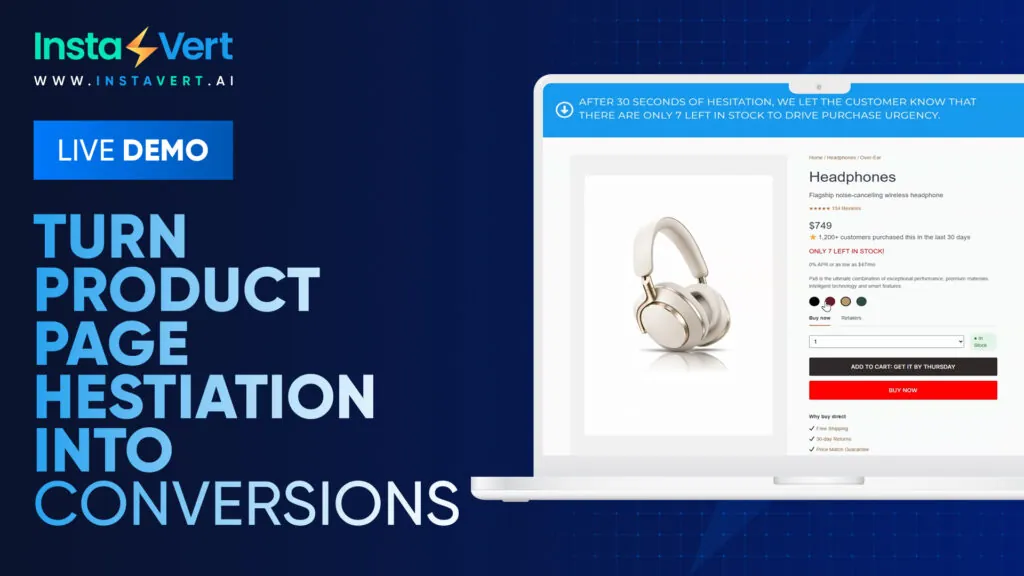
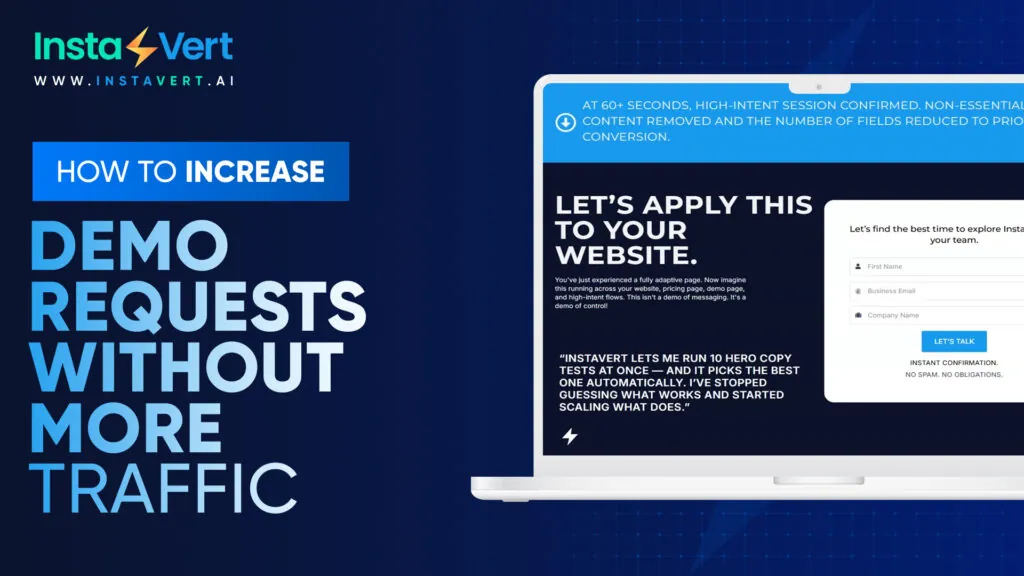
For example, the number of fields on a form might be reduced when hesitation is detected. A demo video could appear when a visitor appears uncertain. A CTA could change based on abandonment signals. An exit-intent experience could appear when the visitor begins leaving.
Instead of presenting one fixed experience, the website becomes more responsive to the behavior occurring during the session.
Moving Beyond Traditional A/B Testing
Traditional A/B testing still provides significant value, but modern buyer behavior moves much faster than traditional optimization cycles were originally designed for.
Many organizations don’t have enough traffic volume to quickly reach statistical significance. Even when testing works well, optimization may occur weeks or months after the original visitor interaction.
Someone leaves your website, you analyze what happened, and then make an improvement.
But that visitor has already left.
Visitors make engagement decisions almost instantly, which is contributing to a broader movement toward more responsive optimization approaches.
Many organizations spend more time analyzing behavior after an opportunity has already been lost than responding to that behavior while the visitor is still actively engaged.
That’s one of the biggest opportunities emerging in modern website optimization.
Creating Adaptive Website Experiences
Modern optimization platforms are becoming increasingly capable of identifying engagement behavior, detecting hesitation, adapting messaging, surfacing trust indicators, and personalizing experiences dynamically.
One area we’ve been exploring at InstaVert is how adaptive experiences can reduce friction while a visitor is still actively engaged.
Historically, optimization happened after the fact.
Organizations reviewed analytics in platforms such as Google Analytics, watched session recordings and heatmaps, studied conversion data, ran tests, and eventually made updates.
But buyers move faster than that.
Visitors are making decisions within seconds. They’re making those decisions while scrolling, evaluating trust, comparing options, and determining relevance.
The opportunity is to make the website itself more responsive during those moments.
If a visitor is heavily engaged with pricing content, revisiting particular sections, hesitating near a conversion point, or showing signs of exit intent, the website experience can become more adaptive and context-aware.
This isn’t about creating gimmicky experiences.
It’s about reducing friction, helping buyers find relevant information faster, building confidence faster, and helping them move through the evaluation process more naturally.
From Static Websites to Behavior-Aware Experiences
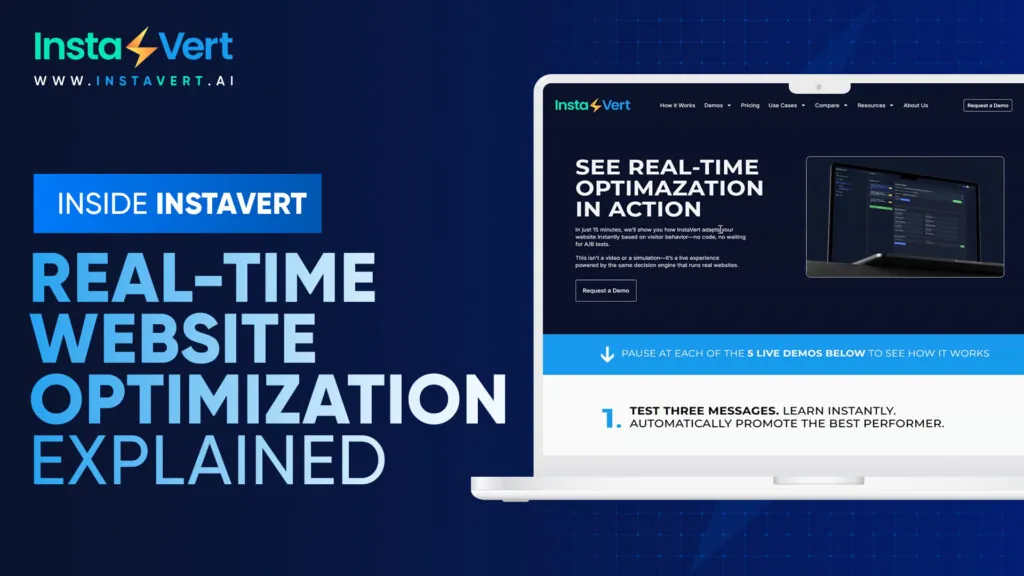
At InstaVert, one of the areas we’re exploring is how websites can become more adaptive and behavior-aware in real time.
The core idea is relatively simple:
Websites shouldn’t remain static while visitors are actively signaling engagement and intent.
Instead of relying entirely on delayed optimization cycles, adaptive systems can interpret behavior, identify potential friction, and improve the experience dynamically.
For example:
Scroll depth may indicate engagement.
Hesitation may indicate uncertainty.
Time spent within a section may indicate interest.
Exit behavior may indicate friction or confusion.
Historically, much of that information could only be analyzed after the session ended.
We’re now moving toward systems capable of responding while the visitor is still engaged.
Adaptive optimization moves optimization closer to the actual moment of decision-making. That creates opportunities not only for stronger conversion rates, but also for better buyer experiences.
Importantly, this trend is larger than any single platform. The broader shift in digital experiences is toward adaptive engagement, reduced friction, greater operational efficiency, and more intelligent responsiveness.
The Future of CRO
The future of CRO isn’t simply better testing.
It’s better decision-making.
Websites are increasingly moving toward becoming context-aware, continuously learning, and increasingly self-optimizing systems.
Historically, websites have been passive. Organizations designed pages, launched them, and periodically updated them.
Digital experiences are becoming much more intelligent and adaptive.
Organizations that adapt quickly, reduce friction, and create responsive buyer experiences will be better positioned to capitalize on this evolution.
It’s also important to recognize that technology doesn’t replace good marketing strategy.
If anything, it amplifies it.
Organizations still need strong messaging, clear positioning, ICP alignment, valuable content, and effective buyer journeys.
Technology simply makes those experiences more responsive and scalable.
Webinar Q&A
How should businesses measure the ROI of their website and marketing efforts?
Laura Whitman:
From your perspective, how should business owners think about measuring the ROI of their website and marketing efforts? And what are the most common disconnects you see between marketing activity and financial results?
John Bertoli:
Start by looking at website conversion.
If you’re successfully driving traffic from multiple channels but only a small percentage of that traffic converts, one way to increase the ROI of your website and marketing investment is to improve the conversion rate.
But don’t stop at the initial website conversion.
Measure what happens after someone fills out a form or completes another meaningful conversion action. How do those engagements translate into pipeline? Are they becoming MQLs, SALs, SQLs, and opportunities? How long does it take them to progress through those stages?
You should also evaluate how you’re delivering the right content to prospects within each stage to encourage the next decision and accelerate pipeline.
When it comes to disconnects between marketing and financial results, alignment is critical.
Marketing, sales, and finance need visibility into who is converting on the website, where those prospects are within the funnel, what each stage looks like, and which marketing activities are helping prospects progress.
The goal isn’t simply to generate more conversions. It’s to improve the velocity and quality of progression from MQL to SAL to SQL to opportunity and, ultimately, revenue.
What should a growing business with limited time and budget prioritize?
Laura Whitman:
For a growing business with limited time and budget, what are the top one or two things it should focus on within its website or marketing strategy to have the biggest impact on growth?
John Bertoli:
The first is optimizing the website instead of simply driving more traffic to it.
If you can convert more of the traffic already visiting your website, you don’t necessarily need to continually increase traffic at the same rate to generate more opportunities.
Driving more and more visitors to a website that isn’t converting properly doesn’t solve the underlying problem.
Focus on improving conversion, incorporating the right content and value validation, adding testimonials, developing stronger case studies, and demonstrating your organization’s expertise.
Those improvements can help convert more existing traffic into meaningful engagement.
The second area I’d focus on is analyzing what’s historically worked and what hasn’t.
Perform a financial and marketing analysis of the channels you’re investing in.
Perhaps events and field marketing produce the strongest ROI despite having a relatively high cost per lead. Maybe webinars are converting exceptionally well. Or perhaps paid advertising is generating leads, but those leads aren’t progressing to MQLs or opportunities.
Use that information to make better resource-allocation decisions.
You may find that you should pull back from one channel and invest more time, budget, and energy into the channels producing stronger business outcomes.
Turn Your Website Into a Growth Engine
A high-performing website isn’t simply a branding asset or a destination for marketing traffic. It can become an active part of your organization’s revenue engine.
That requires aligning the website with your ideal customers, understanding the buyer journey, creating content that builds confidence, reducing conversion friction, measuring performance beyond surface-level engagement metrics, and continuously optimizing the experience.
As website technology becomes increasingly adaptive and responsive, organizations also have an opportunity to move beyond exclusively analyzing what visitors did after they leave and begin improving experiences while those visitors are still actively engaged.
The objective remains straightforward: create a website experience that helps the right buyers understand your value, build confidence, and take the next appropriate step.

 You'll be redirected to Stripe's secure payment page to complete your payment.