
From Audit to Live Changes, Without a Developer
How a New York agency uses InstaVert to find what matters faster and get its CRO recommendations live
|
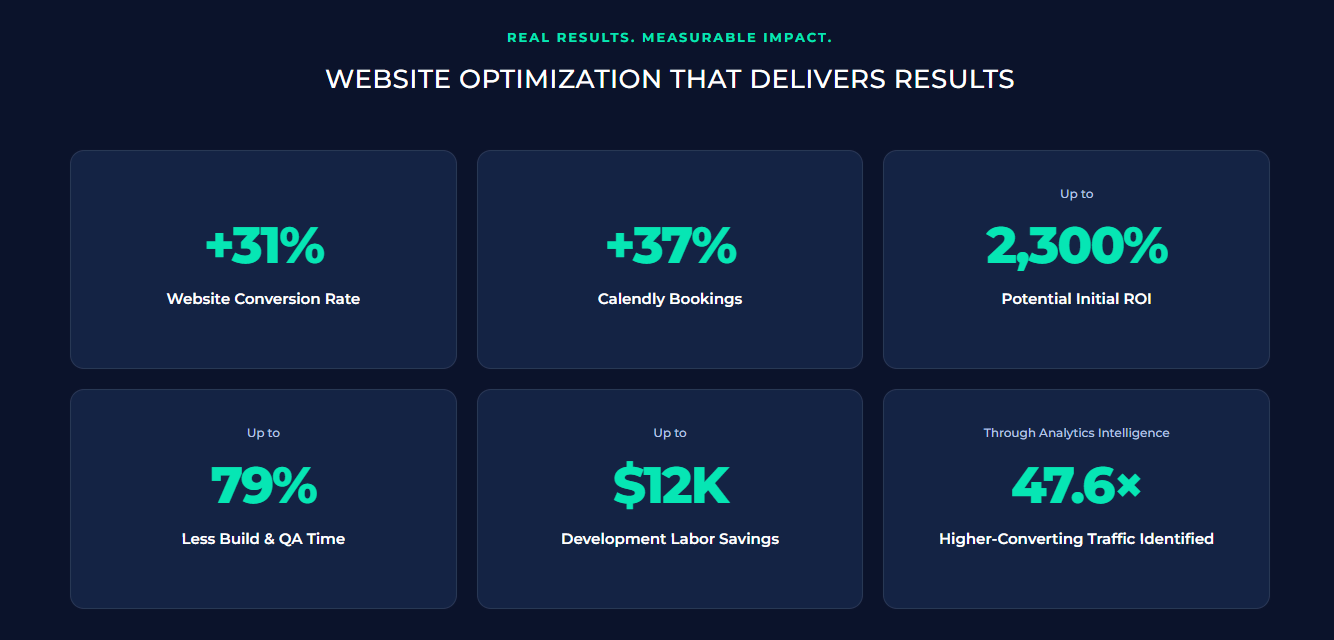
7 site changes live |
32 behavioral rules |
12 overlays |
0 developer tickets |
40–60 hours saved |
|
AT A GLANCE Digital Drew SEM is a New York agency running paid media, SEO and conversion optimization. They complete five to ten CRO audits a week. They tested InstaVert on their own website first, treating it exactly as they would a client’s. Its analytics surfaced their biggest opportunity within the first month of data. They then delivered seven site changes, backed by a measurement framework, as 32 behavioral rules and 12 overlays. There were no developer tickets, and nothing was added to the site beyond a single script installed once. On a conservative reading, the core build saved 40 to 60 hours of hands-on work on that one site. |
The Challenge
An audit has two halves. First, finding what is wrong: pulling traffic, behavior and conversion data together and working out which problems are worth fixing. Second, getting the fixes live.
Both halves were slow. The analysis meant stitching together several tools before they could see a pattern. Delivery meant turning each finding into a developer ticket and waiting for it to reach the top of a queue that was there before they arrived. Across five to ten audits a week, that is where their time went.
Faster audits: finding the opportunity
Once the InstaVert script was on the site, behavior, traffic source, device and conversion data sat in one dashboard, with an AI-written summary of what the numbers meant. The pattern that shaped their whole strategy was clear within the first month.
|
Traffic source (30 days) |
Sessions |
Bounce rate |
Conversion rate |
|---|---|---|---|
|
Direct |
5,535 |
89.1% |
0.09% |
|
Referral (mainly industry directories) |
1,133 |
60.9% |
4.28% |
Referral traffic was 14% of sessions but produced 81% of conversions, converting at 4.28% against 0.09% for direct. These were visitors arriving from directories such as Clutch, already looking for an agency. They were seeing exactly the same homepage as everyone else.
The same dashboard showed where visitors hesitated, how far they scrolled, where rage clicks clustered and how intent split across segments. That is the part of an audit that used to take the longest to assemble. Here it arrived already joined up, so their time went on deciding what to change rather than building the picture.
“The visitors most likely to convert were the ones we were doing the least for. InstaVert showed us that within the first month, and the whole strategy changed shape around it.”
— Drew Blumenthal, Founder, Digital Drew SEM
Faster delivery: getting the changes live
They agreed on seven changes to the site, with a measurement framework behind them, including source tags on the links they added so visits from each change could be followed through to the pages where leads are captured.
- A “Run My Free SEO Audit” call to action on our local SEO service page
- A contact page heading that changes with the page the visitor came from
- An industry-matched case study shown to the right visitor
- Page-specific offers delivered through overlays
- Separate messaging for returning visitors
- Specific treatment for directory and referral traffic
- Mobile-specific adjustments
All seven went live as 32 rules and 12 overlays. The platform reaches the site through a single script installed once. From then on, every change was built, previewed and published inside InstaVert, and each one went live the same day it was approved rather than waiting for a release.
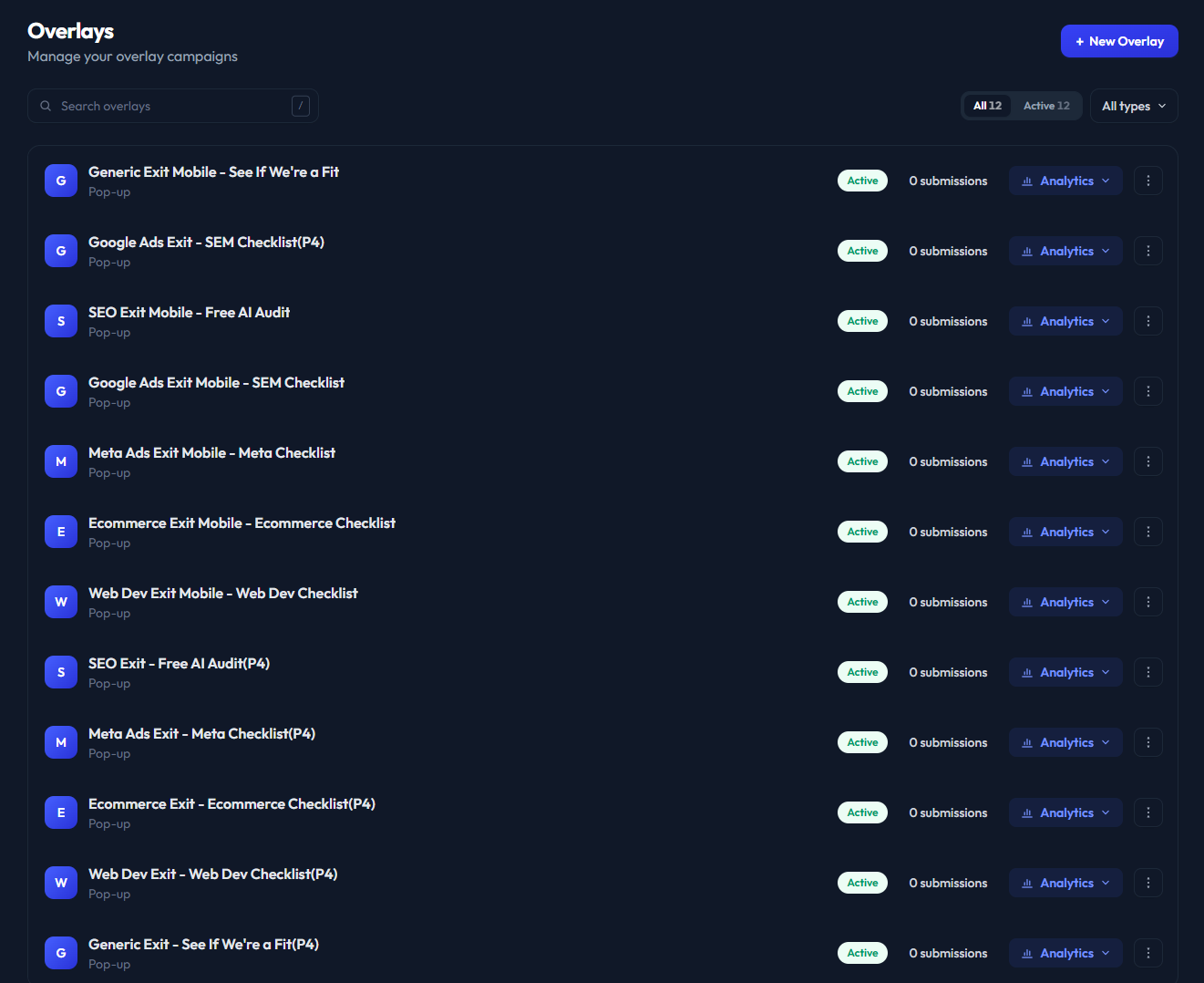
The 12 overlays live on digitaldrewsem.com, each matched to a page and device
The page-specific offers show what that makes possible. Each offer has a desktop and a mobile version, matched to the service the visitor is reading about. It appears after 75 seconds on the page, and only once per visitor. That is three pieces of conditional logic on one element: device, timing and frequency. In a conventional build it is a ticket of its own, and usually the first one cut when time runs short. In InstaVert it was a setting chosen while the rule was being built.
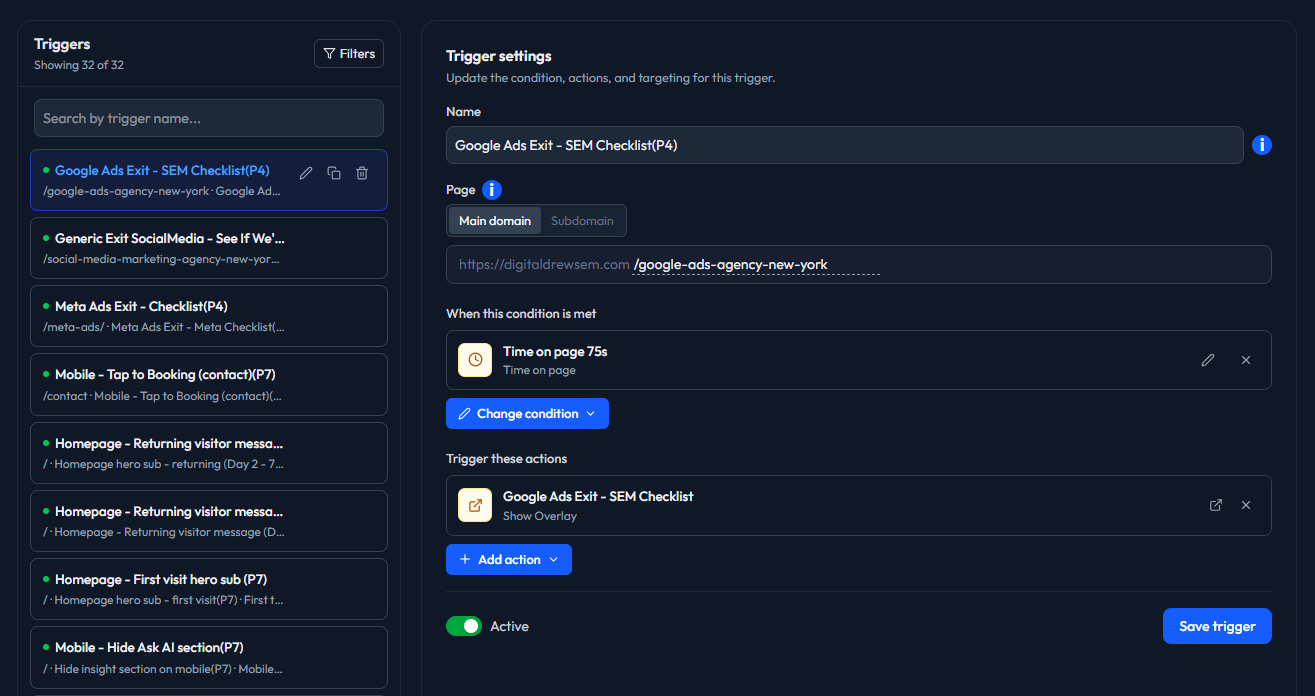
A trigger in InstaVert: the page, the condition and the overlay it shows
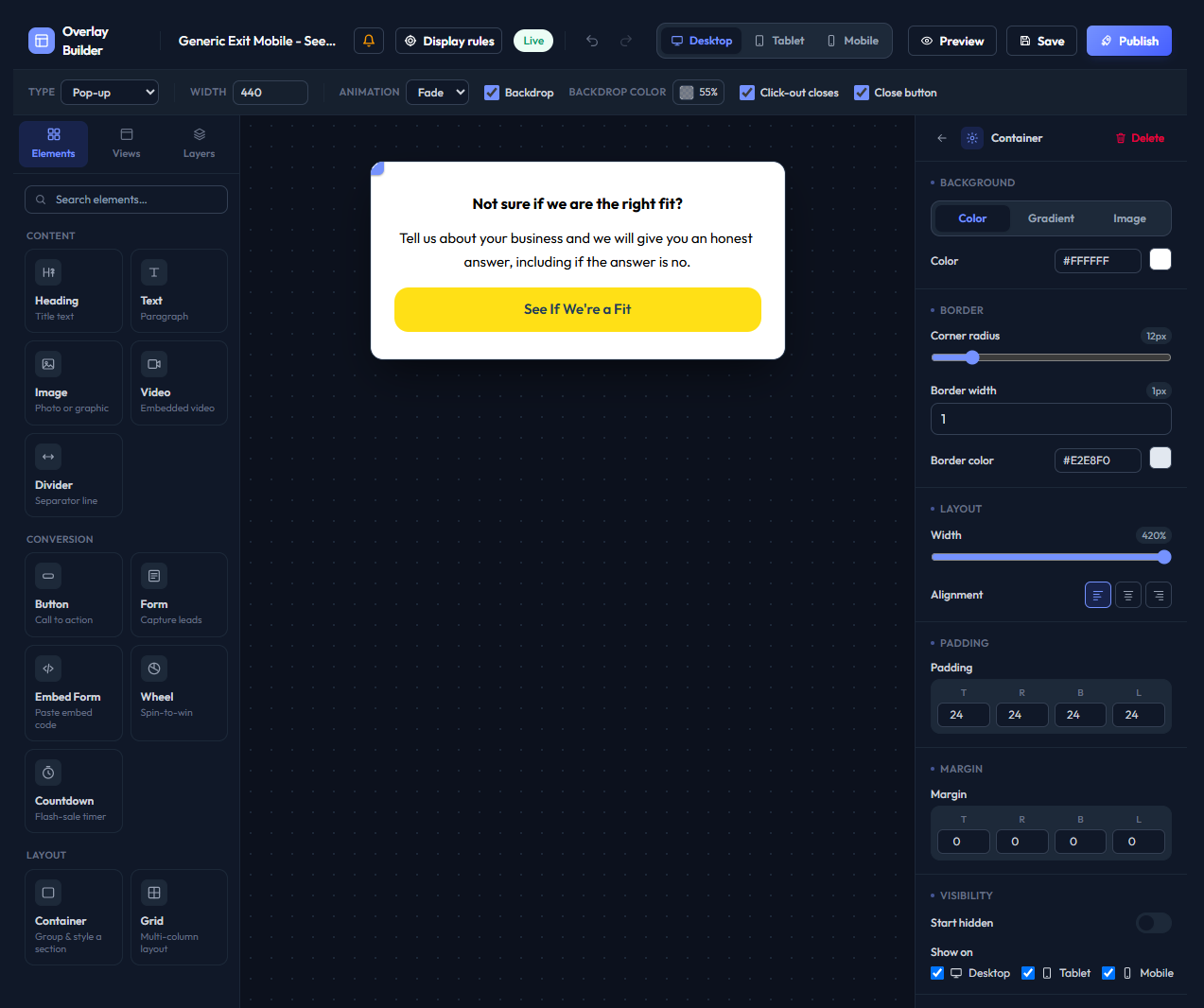
The overlay builder, where each offer was designed without code
The time it saved
The figures below are estimated from their own build. They have shown the arithmetic so another agency can apply its own build times and rates.
|
Per rule, average |
Through a developer |
In InstaVert |
|---|---|---|
|
Specifying the change |
Written brief and ticket |
Built directly from the plan |
|
Build |
2 to 4 hours |
45 minutes to 1 hour |
|
QA |
30 to 45 minutes, separate pass |
15 to 20 minutes, same session |
|
Going live |
Next release window |
Immediate |
|
Reverting or adjusting |
A further release |
in the rule off |
Across the 24 rules in their core build, that difference works out at roughly 36 to 82 hours. They use 40 to 60 hours as their working figure, a conservative reading that allows for some rules being simpler than average. They have since added eight more rules, which are not included in that figure.
The larger saving is elapsed time. Through a development cycle, every one of these changes would have waited for a brief, a queue and a release window. Here, each change went live the same day it was approved, and any part of it can be adjusted or reversed the same afternoon.
Across a portfolio. The same removal of the queue applies to every change on every client site, whether it is one change or forty. With Playbooks, a build like this one can be packaged once and reused across sites, so each new client starts from proven work rather than a blank page.
“The mobile versions of those offers would never have survived a normal build. It would have been the line item we cut to hit the date.”
— Drew Blumenthal, Founder, Digital Drew SEM
The features that did the most work
|
Feature |
What it replaced |
Where they used it |
|---|---|---|
|
Analytics and AI summaries |
Hours stitching together analytics exports and spreadsheets for each audit |
Finding the directory opportunity |
|
Behavioral triggers |
Custom JavaScript written and maintained separately on every site |
Page offers and timing rules |
|
Traffic source detection |
A separate landing page for each campaign or source |
Directory and referral traffic |
|
Previous page detection |
Duplicate pages for every entry path |
Contact page heading |
|
Returning visitor detection |
A cookie layer that needed a developer to build and change |
Returning visitor messaging |
|
Overlay builder |
A design round and a development round for every overlay |
All 12 overlays |
|
Device-specific rules |
Separate mobile logic, usually cut for time |
Desktop and mobile versions of every offer |
|
Experiments |
A separate testing tool and a developer to set up each variant |
Homepage hero call to action |
|
Team & Access |
Shared logins, or a developer as gatekeeper for every publish |
Editors build, admins publish |
|
Activity Logs |
Spreadsheets and memory to track what changed and when |
A full record of every change, by person and time |
What changed for their agency
- They can sell conversion work to more clients. Clients without developer time used to get a list of findings they could not act on. Now they can agree changes in a meeting and have them running without a third party in the middle.
- Retainers have something to show every month. A monthly CRO retainer only works if something changes every month. Without a release cycle in the way, it can.
- Testing ideas is cheap. When reversing a change means switching a rule off, a team tries things it would otherwise debate for a week.
How they run it as an agency
- Start on a site you own. Building on their own website first gave them a working library of rules, naming and structure before they touched a client account.
- Give everyone the right access. With Team & Access, team members build as Editors and an admin publishes, while a client can be given read-only access to their own reporting.
- Use the log as proof of work. Activity Logs record every change with who made it, when and what changed, which gives a client a clear record of the work delivered each month.
- Build to reuse. Name and structure rules so they can be packaged as a Playbook and carried to the next client.
What comes next
Digital Drew SEM is now measuring the impact of the seven changes and will share the results as they come in. Next, they are packaging this build as a Playbook and rolling the same approach out across their client sites, where the saving compounds with every site they add.
|
IF THIS SOUNDS FAMILIAR If your audits land on time but your recommendations do not, count the changes waiting on a client’s development queue right now. That is the size of the problem. See how InstaVert works for agencies: instavert.ai/website-optimization-for-agencies |

 You'll be redirected to Stripe's secure payment page to complete your payment.